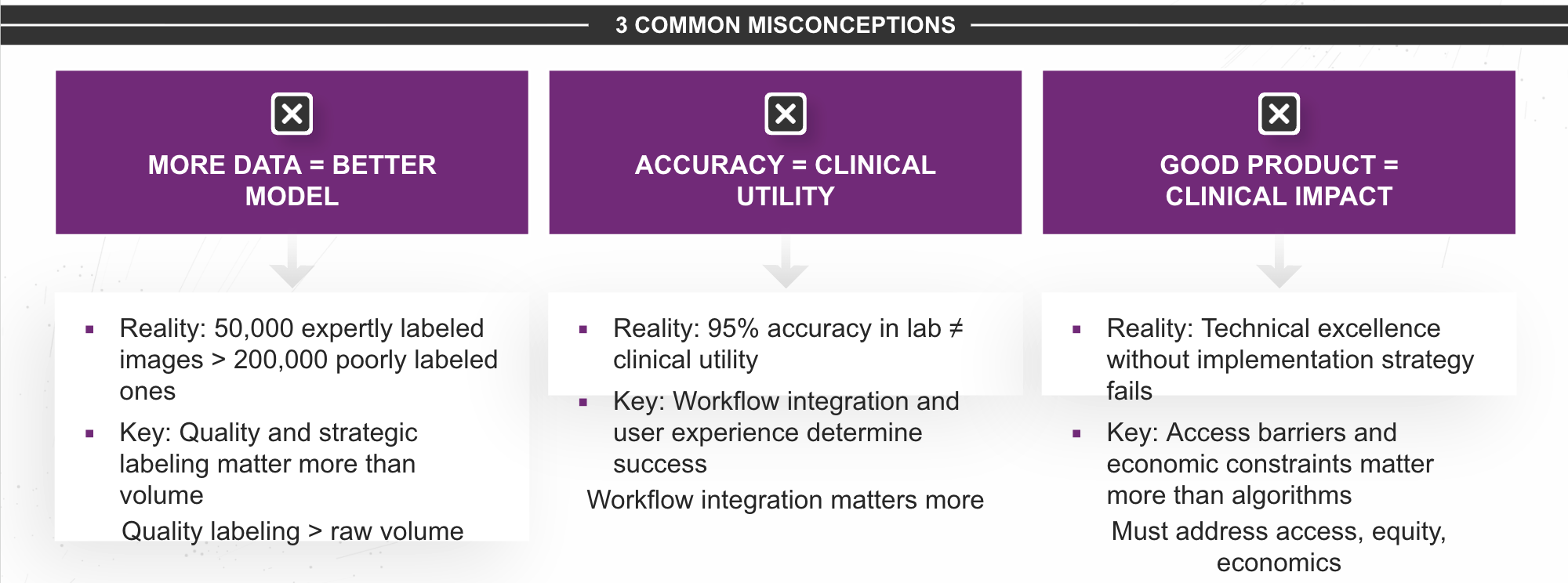
The gap between research promise and clinical reality often stems from three persistent misconceptions. These myths don’t just slow progress; they lead to expensive failures that could otherwise transform patient care.
Myth 1: “More Data is Always Better”
There is a belief that simply accumulating massive datasets guarantees a better model. This is false. In oncology, 50,000 expertly labeled images often outperform 200,000 poorly labeled ones.
Research shows that performance gains plateau after a certain threshold. Adding more “noisy” data offers diminishing returns. The strategic investment should not be in volume, but in establishing robust labeling protocols. Recent advances in self-supervised learning now allow us to use smaller, high-quality datasets to fine-tune foundation models, achieving comparable performance with significantly less data overhead.
Myth 2: “Accuracy Equals Utility”
A model might achieve 95% accuracy in a controlled research environment, identifying lung nodules with superhuman precision. But if that model is deployed without considering the radiologist’s workflow, it will fail.
If a system creates “alert fatigue” or over-refers patients due to image quality variations, the clinical team will stop using it. Technical accuracy is necessary, but it is insufficient for clinical success.
Myth 3: “Good Tech Automatically Creates Impact”
Even the most sophisticated AI fails if it ignores access barriers. Consider the impact of workflow on patient adherence.
Traditional screening workflows, where patients wait days for results, suffer from low adherence. In underserved communities, follow-up rates for serious conditions can drop to 10-20%. However, AI-enabled same-day results can increase patient adherence from 20% to 67%.
The technology didn’t change the medical science; it changed the workflow. That is where the true impact lies.
Authored By: Padmasri Bhetanabhotla