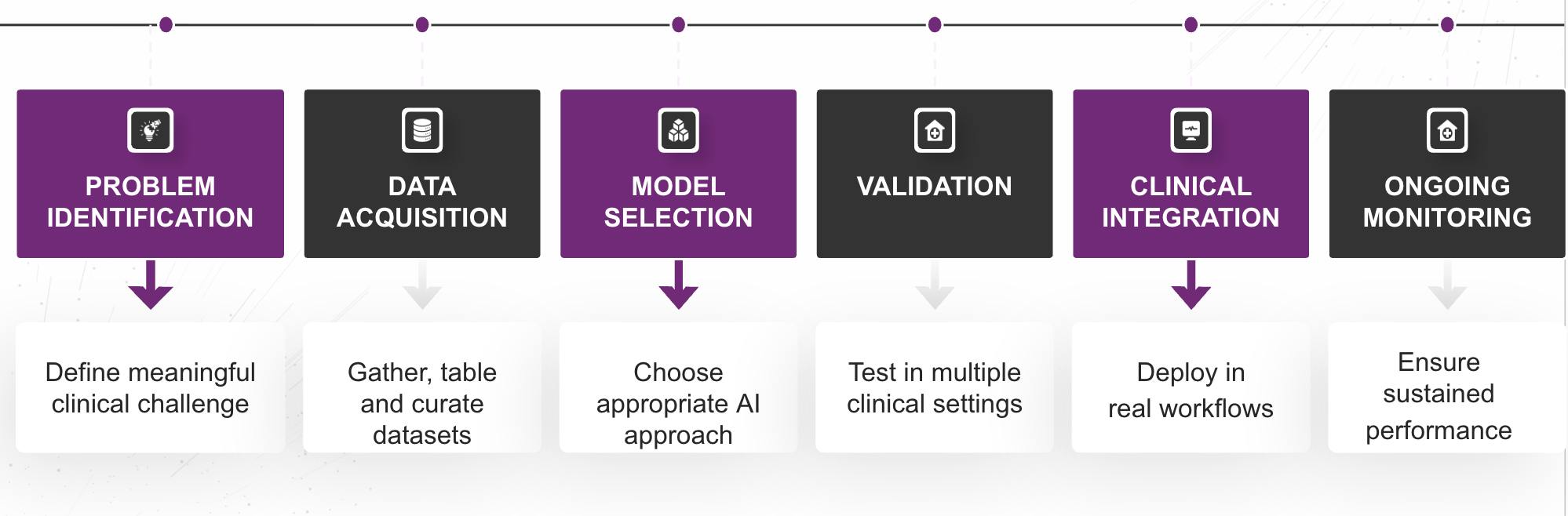
Artificial intelligence holds transformative potential in oncology, yet a persistent paradox remains. Despite a proliferation of research papers and experimental success, the oncology community faces a “translation gap.” We are seeing remarkable algorithms in the lab, but a struggle to convert them into real-world clinical impact.
The problem is rarely the math. Success in oncology AI depends far less on the sophistication of the algorithm and far more on the discipline of how those algorithms are integrated into clinical care.
The Anatomy of Failure (and Success)
To understand why this gap exists, we must look at the development pipeline. The transformation from a concept to a deployable clinical tool involves six critical stages, ranging from problem identification to post-deployment monitoring.
The most common point of failure occurs right at the start: Problem Identification. In radiation oncology, successful AI distinguishes between workflow inefficiencies that AI can meaningfully address (like auto-contouring) versus complex clinical judgments that still require human nuance.
The Three Pillars of Use Case Selection
To bridge the translation gap, every proposed AI project must meet three essential criteria:
- Clinical Significance: Does this solve a genuine bottleneck? For example, organ-at-risk contouring is time-intensive and repetitive, making it a perfect candidate.
- Technical Feasibility: Do we have the data? Is the regulatory pathway clear?
- Workflow Compatibility: This is the most overlooked factor. An AI tool that increases accuracy by 1% but adds 10 minutes to a clinician’s day will fail.
The Path Forward
The true measure of an AI model’s success in oncology lies not in its mathematical precision, but in its ability to enhance clinical confidence. By shifting our focus from “building smarter models” to “building useful tools,” we can finally close the gap between experimental promise and patient care.
Authored By: Padmasri Bhetanabhotla