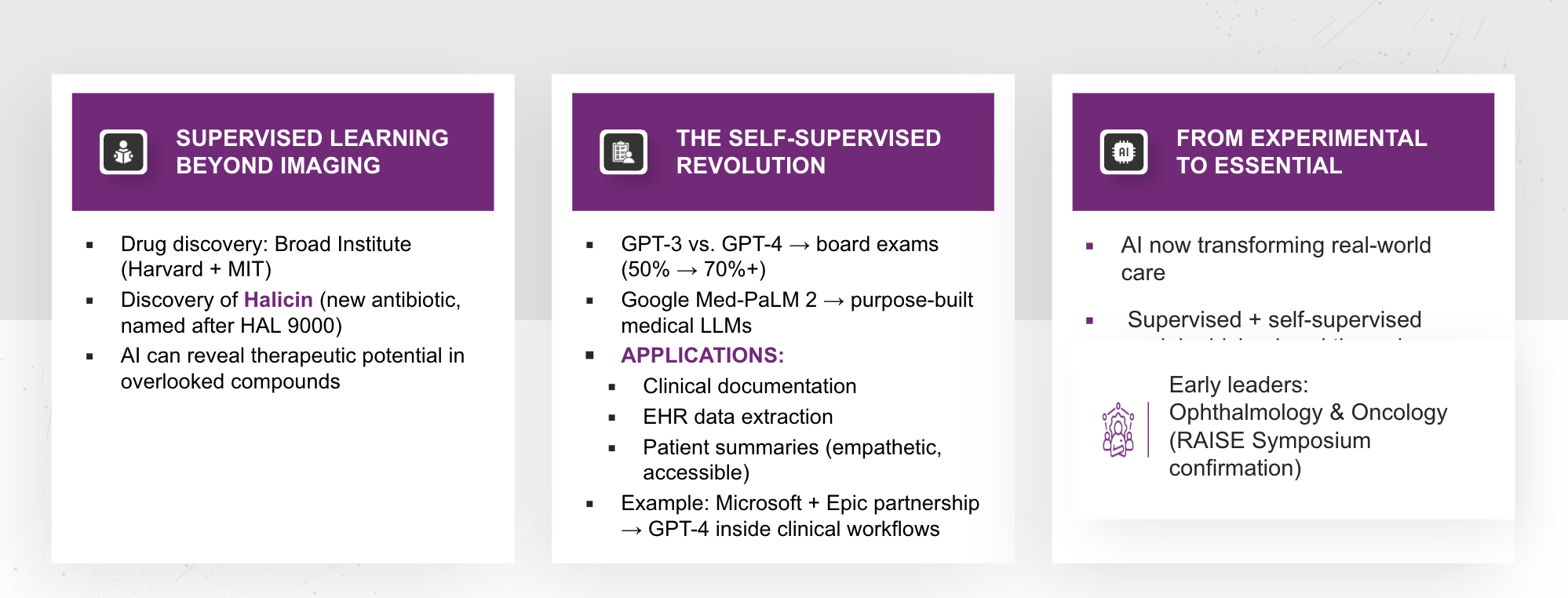
While the 2016 era was defined by pattern recognition, today’s AI revolution is defined by reasoning and language. We have entered the era of Self-Supervised Learning and Large Language Models (LLMs).
The Era of Medical Reasoning
The progress has been exponential. GPT-4 is capable of scoring over 70% on specialized medical board exams, a significant leap from its predecessors. Similarly, Google’s Med-PaLM 2, trained specifically for healthcare, produces clinically consistent, evidence-based responses.
This capability bridges the gap between basic “AI fluency” and true “medical accuracy.” Beyond clinical reasoning, these models are reshaping administration through automatic documentation, data extraction from EHRs, and partnerships that integrate directly into clinical workflows.
Generative Biology and Drug Design
The convergence of self-supervised learning and generative modeling is opening a new frontier in drug design as well. Diffusion models, originally used for generating images, are now being used to create novel protein therapeutics. Recent advances demonstrate models capable of designing previously unknown proteins with targeted therapeutic properties, signaling an era where AI dramatically compresses drug discovery timelines from lab discovery to clinical deployment.
Why Oncology is the Natural Frontier
Among all medical fields, oncology stands out as the most fertile ground for these innovations. The specialty is naturally aligned with AI because of its data-rich workflows, high-stakes precision requirements, and the prevalence of repetitive, rule-based tasks like auto-contouring and QA checks.
Unlike other specialties where AI can feel forced, oncology’s pain points are directly addressed by automation. This is why radiation oncology departments report some of the highest AI adoption rates in medicine; the tools directly reduce cognitive load rather than adding to it.
The Partnership Model
Ultimately, AI’s trajectory in healthcare is no longer about technological capability. It is about collaborative execution. The most successful implementations feature bidirectional feedback loops among clinicians, data scientists, and developers. True, scalable value emerges when AI augments, rather than replaces, domain expertise. The future of medicine isn’t machine versus clinician. It is machine and clinician working better together.
Authored By: Padmasri Bhetanabhotla