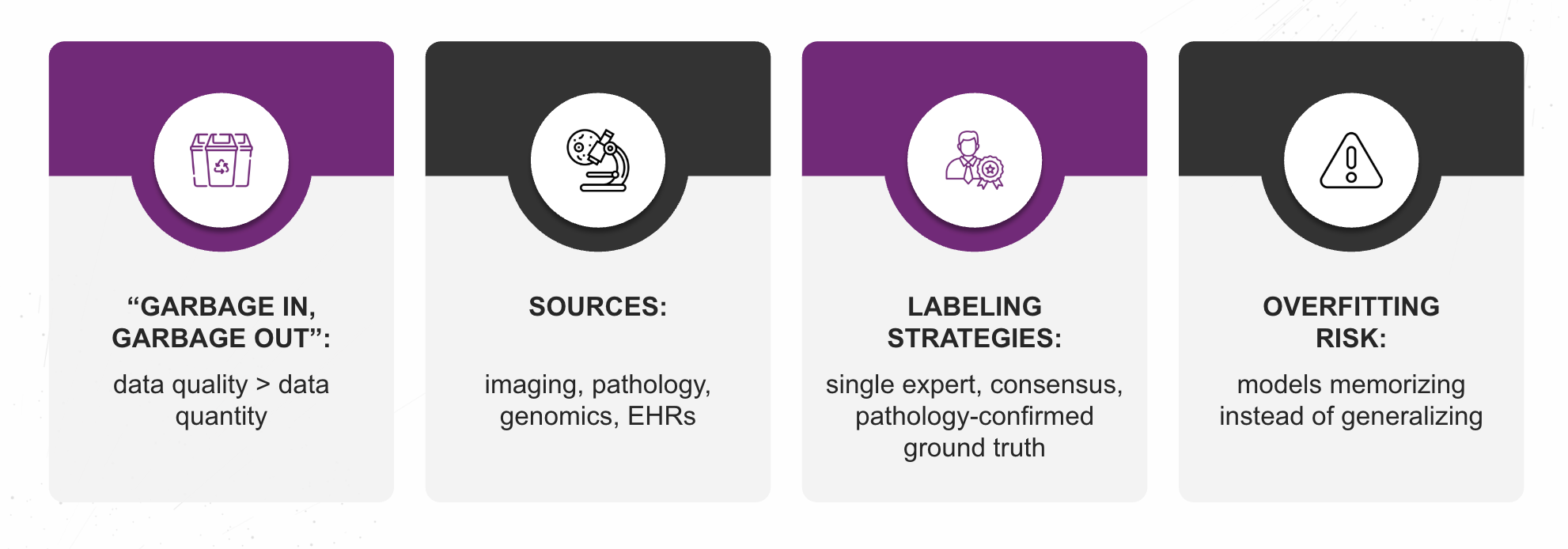
Data quality determines everything. Sophisticated algorithms cannot compensate for biased or poorly curated datasets. But once you have the data, how do you train a model that is safe for patients?
The “Garbage In, Garbage Out” Reality
In radiation oncology, data acquisition is uniquely complex. We aren’t just dealing with spreadsheets; we are dealing with high-resolution CT/MRI images, dose distributions, and longitudinal outcomes.
The first step is Data Curation. This involves cleaning the physician-labeled datasets to ensure they represent diverse patient populations. If a model is trained only on data from one specific scanner or one demographic, it will fail when introduced to a new environment.
The Danger of Overfitting
The biggest risk during the training phase is Overfitting.
Imagine a medical student who memorizes practice cases word-for-word instead of understanding the diagnostic principles. They might score 100% on the practice test, but they will fail catastrophically when they see a real patient with slightly different symptoms.
An overfitted AI model does the same thing. It memorizes the training data rather than learning generalizable patterns. To prevent this, developers must use Cross-Validation—testing the model on data it has never seen before—and ensure the model is trained on diverse tumor presentations rather than memorizing specific cases.
Choosing the Right Data
Not all data types are equal. Deep learning excels with unstructured data like images and text because they contain inherent patterns. However, for tabular data (spreadsheets), traditional predictive models often perform better. Knowing which engine to use for which fuel is the hallmark of a mature development team.
Authored By: Padmasri Bhetanabhotla