Introduction: The Paradox of Excellence
The cancer care landscape is characterized by incredible technological breakthroughs. Specialized AI tools are achieving milestones in diagnostics and planning that were impossible just a few years ago.
Yet, these individual achievements often create a paradox: Fragmented Excellence—powerful but disconnected point solutions that fail to scale or integrate effectively into the complex, multi-disciplinary oncology workflow.
The true value of AI is not in its raw computing power, but in Workflow-Native Integration—an approach MedLever has mastered to solve the industry’s most critical adoption challenge.
Current AI Applications: Specialized Power, Siloed Results
AI now supports many specialized domains, each delivering focused, yet often isolated, results:
- Radiation Planning and Contouring: Automated tumor delineation to save time.
- Clinical Documentation & Workflow Automation: Streamlined note generation and data entry.
- Treatment Decision Support: Predictive models for optimal therapy selection.
- Imaging & Diagnostics: Pattern recognition in radiology and pathology.
- Quality Assurance & Dose Optimization: Adaptive QA protocols and predictive dose modeling.
The Integration Gap: Why Fragmentation Kills Scale
These innovations often remain siloed point solutions, creating the critical Integration Gap. Healthcare systems managing multiple AI vendors face severe, compounding bottlenecks:
- Fragmented Data: Data silos prevent the longitudinal analysis and unified patient view necessary for coordinated care.
- Workflow Inefficiency: Clinicians face constant disruption and mandatory system switching, which negates the time savings promised by the AI itself.
- Redundant Costs & Training Demands: Managing multiple vendor contracts, APIs, integration layers, and diverse training programs leads to dramatically increased operational costs.
MedLever’s Workflow-Native Differentiation: Orchestrating the Entire Care Team
Rather than developing isolated AI tools, MedLever embeds AI directly into the oncology workflow, transforming fragmentation into seamless integration.
Built for End-to-End Care
MedLever is built for radiation oncology end-to-end, supporting the full patient journey from initial consultation through follow-up. This comprehensive approach ensures continuity of data and process.
The Orchestrator Platform
MedLever’s platform acts as an orchestrator for the full care team—physicians, physicists, dosimetrists, therapists, nurses, and administrative staff—unifying every step of care delivery across the department.
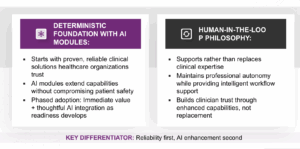
Human-in-the-Loop Design
AI modules are designed to enhance—not replace—human expertise. The platform is built on a core deterministic foundation that ensures reliability and safety, maintaining clinician trust and decision authority.
Phased and Scalable Adoption
MedLever supports gradual readiness. Institutions can activate specific modules when ready, easing the implementation burden, maintaining compliance, and mitigating the risk of massive initial system change.
Conclusion: Integration is the New Innovation
The future of AI in oncology isn’t about which tool has the most advanced algorithm, but which tool is the most integrated.
By prioritizing workflow and unification, MedLever’s approach moves the industry past the limitations of fragmented excellence and into the era of Workflow-Native Integration, where innovation achieves scalable, measurable clinical impact.
Authored By: Padmasri Bhetanabhotla