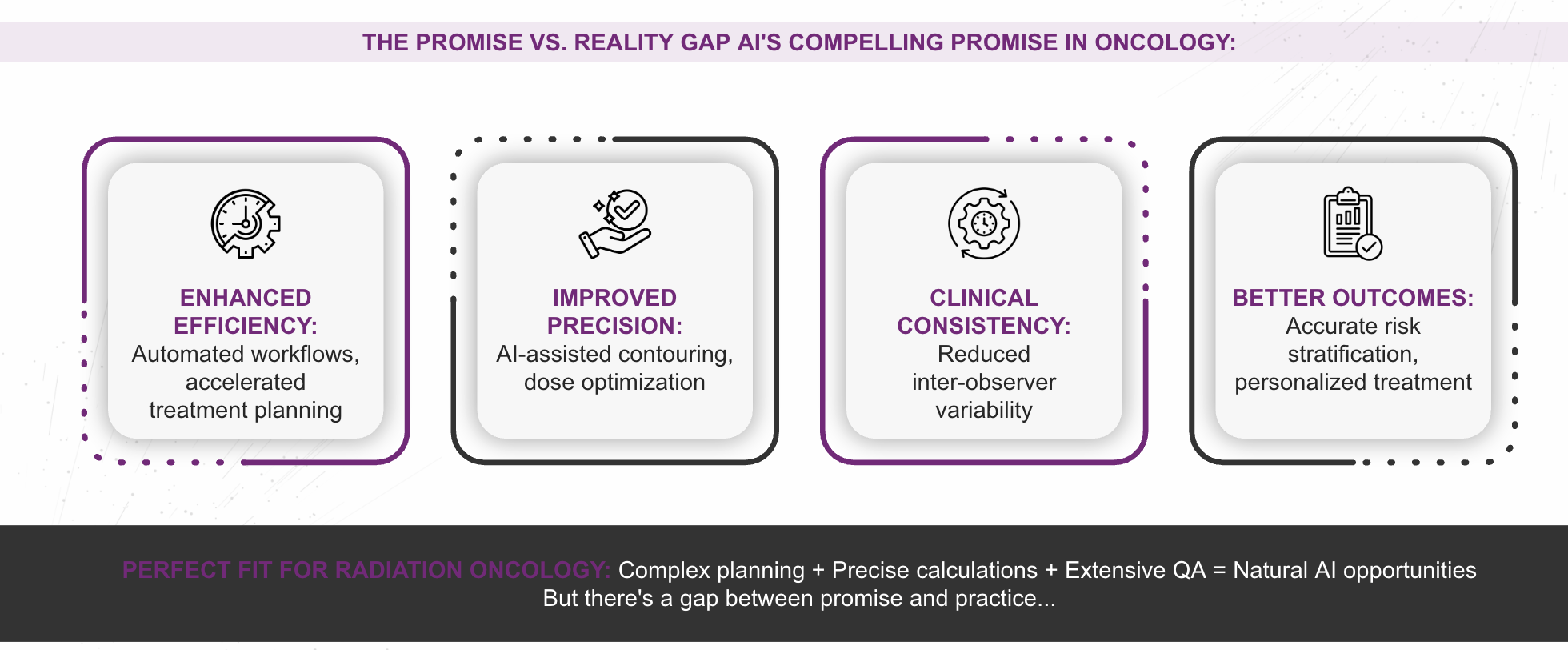
AI technologies offer compelling benefits across the cancer-care continuum:
- Efficiency: Automated workflows that reduce administrative burden and accelerate planning.
- Precision: AI-assisted contouring, dose optimization, and plan refinement that improve consistency.
- Consistency: Reduced inter-observer variability in diagnosis and treatment.
- Improved outcomes: Better risk stratification, personalized treatment, and proactive intervention.
These advantages are particularly relevant to radiation oncology, where complex planning, dose calculation, and quality assurance provide natural opportunities for AI augmentation.
Implementation Challenges: The Reality Gap
Despite potential, real-world deployment faces persistent barriers:
- Data quality: Many institutions lack clean, standardized, and representative datasets.
- Integration complexity: Single-use tools disrupt workflows rather than streamline them.
- Clinician trust: AI must produce transparent, explainable insights that complement human judgment.
- Regulatory compliance: Organizations must balance innovation with patient-safety oversight.
Addressing these challenges requires workflow-native AI integration — the principle at the core of MedLever’s design philosophy.
Authored By: Padmasri Bhetanabhotla