In the race to deploy AI in healthcare, headlines are often dominated by impressive accuracy scores. A model boasting “99% accuracy” sounds revolutionary—but in the nuanced world of oncology, a single metric can hide dangerous flaws. To build systems that clinicians can actually trust, we must look beyond the surface. We need a rigorous evaluation framework that reflects the complexity of real-world patient care, not just the sterile conditions of a computer lab.
AI Model Evaluation: A Comprehensive Framework
Healthcare AI evaluation requires multiple complementary measures to ensure models perform reliably in clinical settings. This approach moves far beyond simple accuracy metrics to address the complex realities of medical decision-making.
Foundational Measures: Sensitivity and Specificity
Sensitivity measures how well a model identifies patients who actually have the condition (true positive rate).
Specificity measures how accurately it rules out patients who don’t (true negative rate).
These address different clinical priorities: sensitivity focuses on catching all cases, while specificity prevents unnecessary anxiety and procedures from false alarms.
However, sensitivity and specificity alone can be misleading. A model with 80% sensitivity and 20% specificity might seem superior, but it is as problematic as one with 20% sensitivity and 80% specificity—both create unacceptable trade-offs.
Probabilities, Not Absolutes
Modern AI models output probabilities, not binary answers. For instance, a patient might be assigned a 12% chance of breast cancer rather than a simple “yes” or “no.”
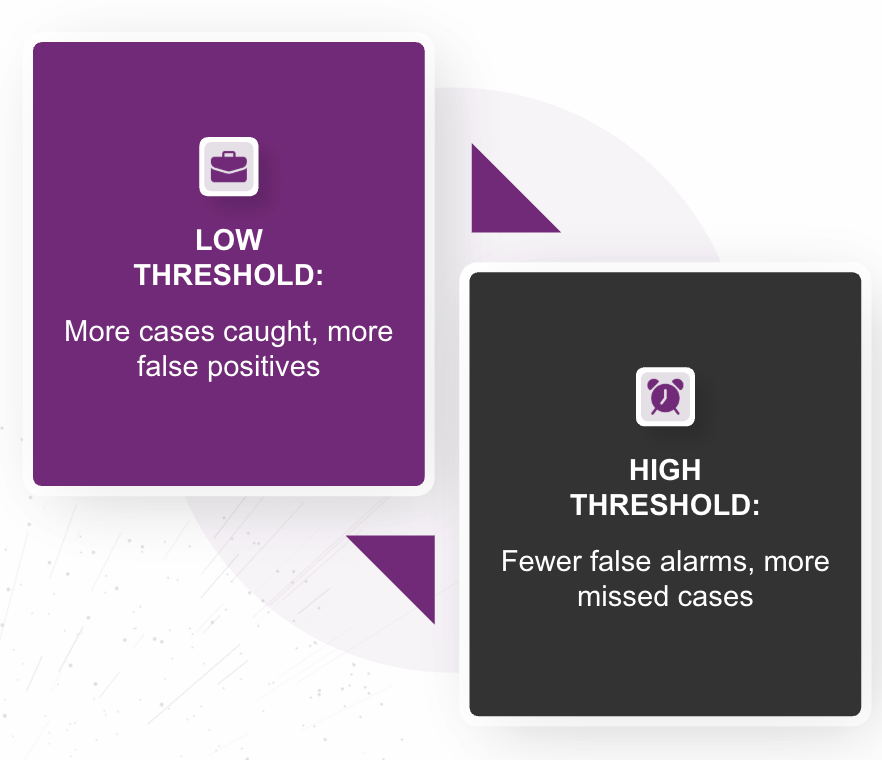
To translate this into action, clinicians apply a threshold—above a certain risk, the result is treated as positive; below, as negative. The threshold choice profoundly influences sensitivity and specificity:
- Lower thresholds catch more cases but increase false alarms.
- Higher thresholds reduce false positives but risk missing critical diagnoses.
Threshold-Independent Measures
Because thresholds vary based on clinical context, robust evaluation relies on threshold-independent measures:
Discrimination: How well the model separates patients with disease from those without (often visualized via the ROC curve).
Calibration: How closely predicted probabilities align with real-world outcomes (e.g., of all patients predicted to have a 20% risk, do 20% actually have the disease?).
Both provide a fuller picture of whether the model is clinically meaningful or merely mathematically optimized.
Conclusion: From Math to Medicine
Ultimately, an AI model is only as good as its ability to improve patient care. By adopting this comprehensive framework—prioritizing calibration and discrimination alongside standard metrics—we move beyond abstract mathematics and into the realm of clinical utility. This shift is essential for ensuring that the AI tools of tomorrow are not just “accurate” on paper, but safe, effective, and truly ready for the bedside.
Authored By: Padmasri Bhetanabhotla