Introduction: The End of the “Wild West”
For the past few years, healthcare AI has been defined by a race for capability. Who has the smartest algorithm? Who has the highest AUC? Who can process data the fastest?
But as we conclude the governance arc of our Beyond Point Solutions series, one truth has become undeniable: The future of healthcare AI will not be defined by how advanced algorithms become, but by the strength of the systems that govern them.
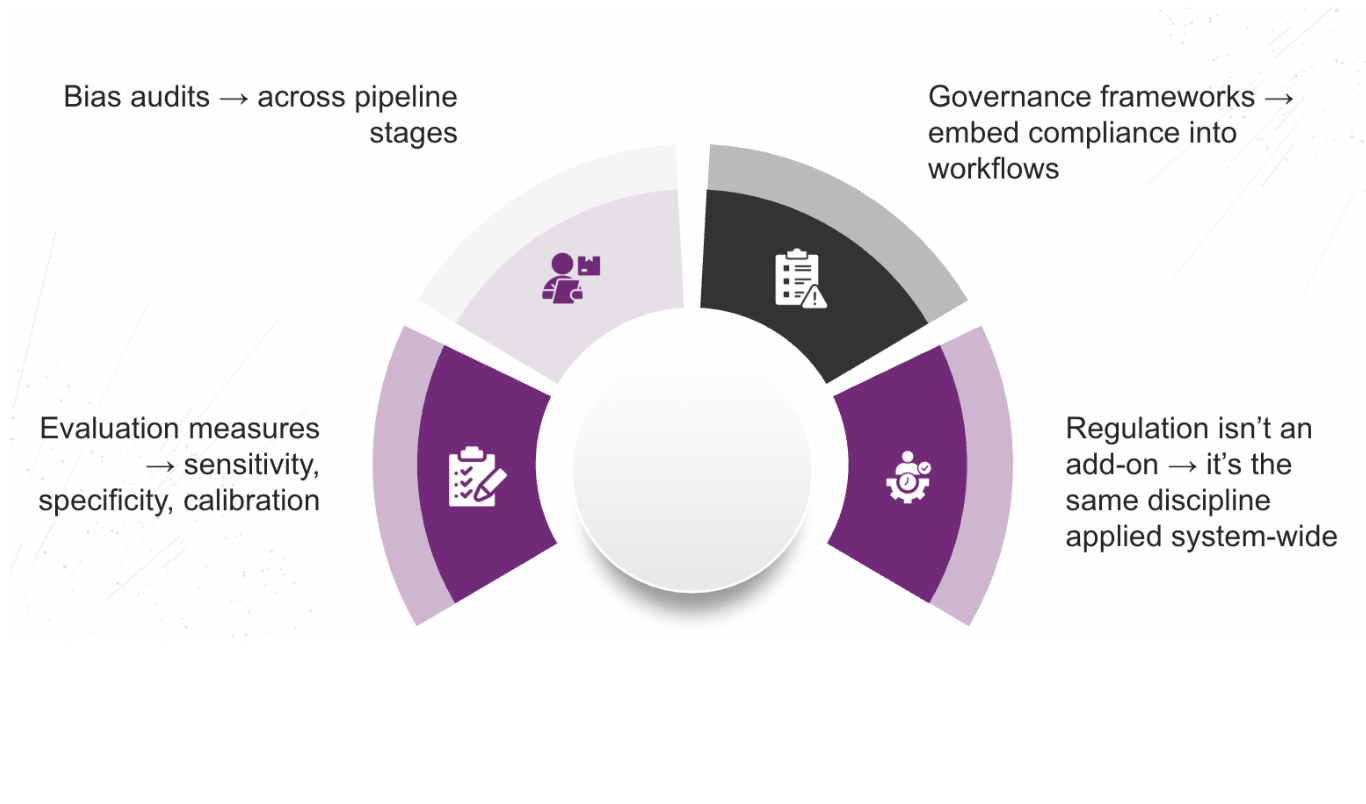
Effective regulation is what transforms AI from a promising experiment into a trusted clinical partner. It safeguards patients and institutions alike through transparency, equity, and auditability.
The Global Shift: Insights from the 2025 HAI Index
The findings from the 2025 HAI Index underscore a massive global shift. We are moving from an era of “Innovation at All Costs” to an era of “Responsible Implementation.”
The index reveals a critical Governance vs. Practice Gap. While corporate awareness of ethical risks is high, actual corrective action is lagging. Governments are stepping in to close this gap, with AI-related regulations doubling in the U.S. and harmonized frameworks emerging globally.
The Strategic Implication: Responsible AI implementation—not algorithmic innovation—now defines competitive advantage. As model performance gaps narrow (meaning many vendors now offer “good enough” accuracy), the differentiator becomes trust. Healthcare organizations that establish internal governance frameworks today—including bias auditing, transparent documentation, and multidisciplinary oversight—will be best positioned as regulation tightens.
The Path Forward: Workflow is the Final Test
Governance cannot exist in a vacuum. It must live where the work happens.
The final test for AI innovation is operability within real-world clinical workflows. You can have the most unbiased, perfectly calibrated model in the world, but if it sits outside the clinician’s daily workflow—or if its recommendations are opaque—it is useless.
What Comes Next?
Having shown why oversight and transparency are essential, the next phase of our series examines how leading organizations operationalize those principles.
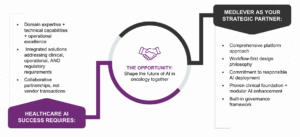
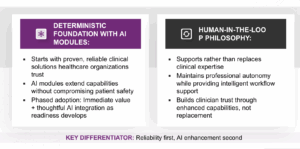
Our forthcoming paper will highlight MedLever’s workflow-first differentiation. We will explore how “embedding” governance directly into the clinical workflow serves as the ultimate safety net—a tangible example of translating regulatory readiness and ethical design into scalable, real-world clinical impact.
Authored By: Padmasri Bhetanabhotla