Introduction: The Question Matters More Than the Answer
In the second stage of our pipeline analysis, we face a subtle but dangerous source of bias: Outcome Definition.
We often assume that labeling data is a neutral task—simply identifying what is in an image or a chart. But AI development often falls into a trap known as the Descriptive vs. Normative Gap. We label data descriptively (“Does this patient show X?”), but we deploy models for normative use (“Should this patient receive Y?”).
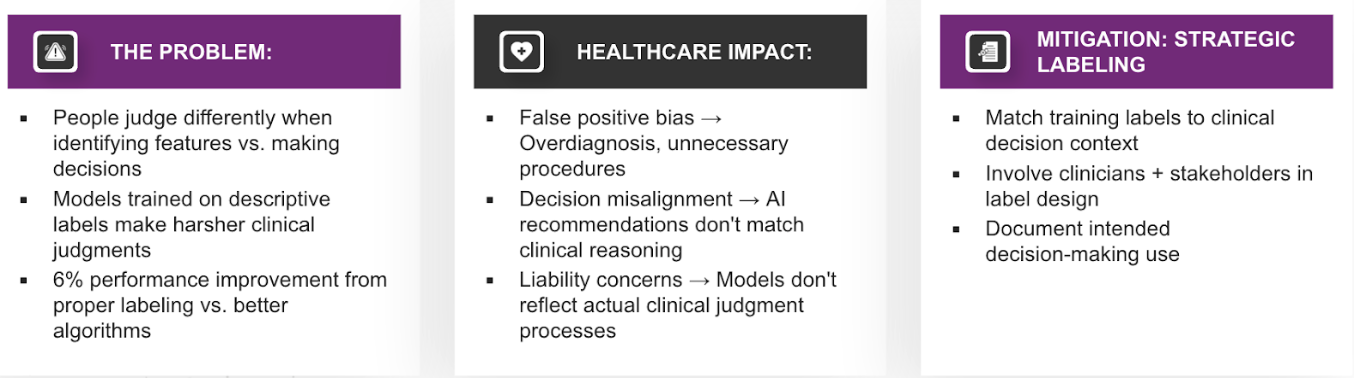
This misalignment seems minor, but it biases predictions toward harsher judgments, leading to over-diagnosis and unnecessary intervention.
The Descriptive vs. Normative Gap
To understand this gap, consider a non-medical example involving meal classification.
- When labelers were asked the descriptive question: “Does this meal have high sugar content?”, 17 out of 20 said yes.
- When the prompt was reframed as the normative question: “Does this meal violate a policy?”, only 2 out of 20 said yes.
The facts of the meal didn’t change. The intent of the label changed. When we ask a model to find “sugar” (descriptive) but use it to enforce “policy” (normative), we create a massive disconnect.
Why This Matters in Healthcare
In oncology, this mismatch is critical. If we train an AI on the descriptive label “Is there a shadow on this scan?” but use the model to answer the normative decision “Should we initiate radiation?”, the model will inevitably over-flag patients.
This leads to three specific failures:
- False Positive Bias: The model optimizes for detection rather than decision, causing over-diagnosis and overtreatment.
- Context Misalignment: The clinical nuance of why a doctor might choose to watch-and-wait is lost.
- Liability Risk: The AI’s recommendations misrepresent provider judgment, creating legal vulnerability.
The “Algorithm” Myth
We often think the solution to better performance is a more complex algorithm. The data suggests otherwise.
Research indicates that improving labeling protocols—specifically aligning them with the real-world decision context—can yield a greater than 6% performance improvement. This is often a larger gain than you would get from upgrading the neural network architecture itself.
Strategic Implications
These gaps distort our evaluation metrics. Descriptive labels optimize for detection; normative labels optimize for decision. If you use the wrong one, your calibration and threshold selection will be meaningless.
To fix this, organizations must:
Document Intent: Explicitly state the intended decision use for each model to ensure training intent equals deployment reality.
Align Labeling with Context: Don’t just ask “What is this?” Ask “What would we do about this?”
Involve Clinicians: Engineers cannot design decision labels; only providers understand the threshold for intervention.
Authored By: Padmasri Bhetanabhotla