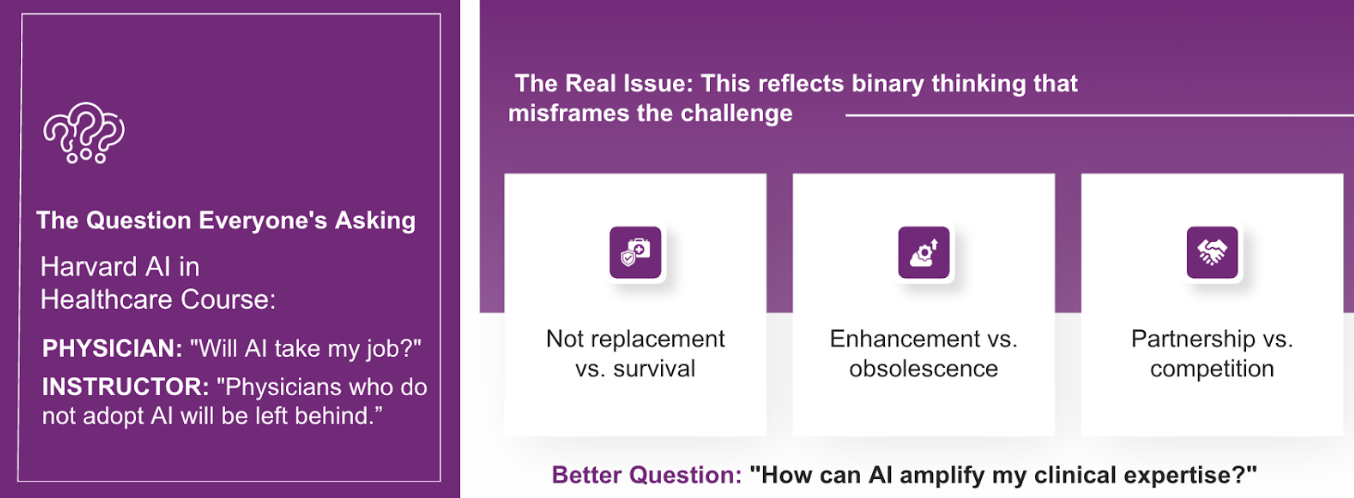
“Physicians who do not adopt AI will be left behind.”
That striking statement came during an office hours session in Harvard’s AI in Healthcare course, when a practicing physician voiced a question that keeps many clinicians awake at night:
“Will AI take my job?”
The instructor’s answer reframed the conversation entirely. Clinicians aren’t facing replacement by artificial intelligence — they’re facing a choice between enhancement and obsolescence.
The Fear Factor: Understanding Clinician Anxiety
The anxiety is understandable.
Headlines frequently proclaim that AI can:
- Diagnose skin cancer more accurately than dermatologists
- Read radiology scans with “superhuman” precision
- Predict patient outcomes before symptoms emerge
For physicians who spent years mastering pattern recognition and clinical reasoning, these developments can feel existentially threatening.
In radiation oncology, the fear often takes specific forms:
- Auto-contouring systems that delineate organs in minutes rather than hours
- Treatment planning algorithms that automatically optimize dose distributions
- Quality assurance tools that detect subtle errors a human might miss
It’s easy to see why the instinctive reaction might be defensive:
“If a machine can do what took me years to learn, what value do I provide?”
Reframing the Narrative: AI as Professional Amplifier
Here’s the truth: AI doesn’t replace clinical judgment — it amplifies it.
Think of AI as a co-pilot, not a competitor.
A radiation oncologist who once spent hours contouring now has the bandwidth to focus on:
- Complex treatment decisions
- Patient consultation and communication
- Multidisciplinary collaboration
AI takes on the repetitive, time-intensive tasks, reducing burnout and freeing clinicians to concentrate on what machines can’t replicate: empathy, ethical reasoning, nuanced decision-making, and the art of medicine itself.
AI empowers clinicians to practice more human medicine — not less.
The Competitive Advantage Paradigm
Forward-thinking clinicians are recognizing AI adoption as a career accelerant, not a threat.
The oncologist who embraces AI doesn’t become redundant — they become:
- More efficient, completing routine tasks faster
- More consistent, with algorithm-assisted precision
- More capable, handling higher patient volumes and more complex cases
With AI-assisted tools, these clinicians can deliver faster turnaround times, higher accuracy, and greater value — all while maintaining a patient-centered focus.
In the evolving landscape of healthcare, the question isn’t “Will AI take my job?”
It’s “Am I ready to work alongside AI to do my job better?”
Key Takeaway
AI isn’t a replacement for clinicians — it’s a force multiplier for their expertise. The future belongs to those who learn to lead with AI, not fear it.
Authored By: Padmasri Bhetanabhotla